Rookie Nurse Saved the SEAL Admiral — 20 Minutes Later, Ten Black SUVs Surrounded the Hospital
A rookie nurse thought she was just doing her job… until she saved a SEAL Admiral with five bullet wounds that surgeons couldn’t fix. Twenty minutes later, ten unmarked black SUVs surrounded the hospital—looking not for the Admiral, but for her.
What they discovered about her past, her training, and the classified mission she survived changed everything. This emotional, high-stakes medical‑military story reveals the truth about quiet heroes, hidden identities, and the moment a forgotten combat medic is finally seen. If you love dramatic nurse stories, special‑operations mysteries, and unstoppable underdog heroes, this one will stay with you long after it ends.
11:47 p.m.
A stretcher crashed through the doors.
A Navy SEAL admiral lay motionless, his uniform torn with five bullet holes, blood pouring through the fabric as surgeons yelled over each other.
“Pressure dropping! We’re losing him!”
They tried everything.
Nothing worked.
Then the quiet rookie nurse stepped forward.
Emma Clark. The girl no one trusted. The one everyone overlooked.
She leaned over the admiral, placed two fingers on his neck, and whispered, “Not yet.”
Her hands moved faster than the surgeons. A maneuver none of them recognized, one she learned in Afghanistan.
The monitor spiked. His vitals stabilized.
The room froze.
The surgeons stared at her like she’d done the impossible.
Ten minutes later, they fired her for breaking protocol.
Emma walked out of the hospital in silence.
And that’s when ten black government SUVs screeched to a stop in front of her.
Agents stepped out. Not for the admiral.
For her.
Because she wasn’t just a rookie nurse.
She was the last surviving combat medic of a classified SEAL unit wiped out in Afghanistan.
And tonight, they wanted answers.
Before we begin, take two seconds to comment where you’re watching from and hit subscribe. Your support truly keeps these stories alive.
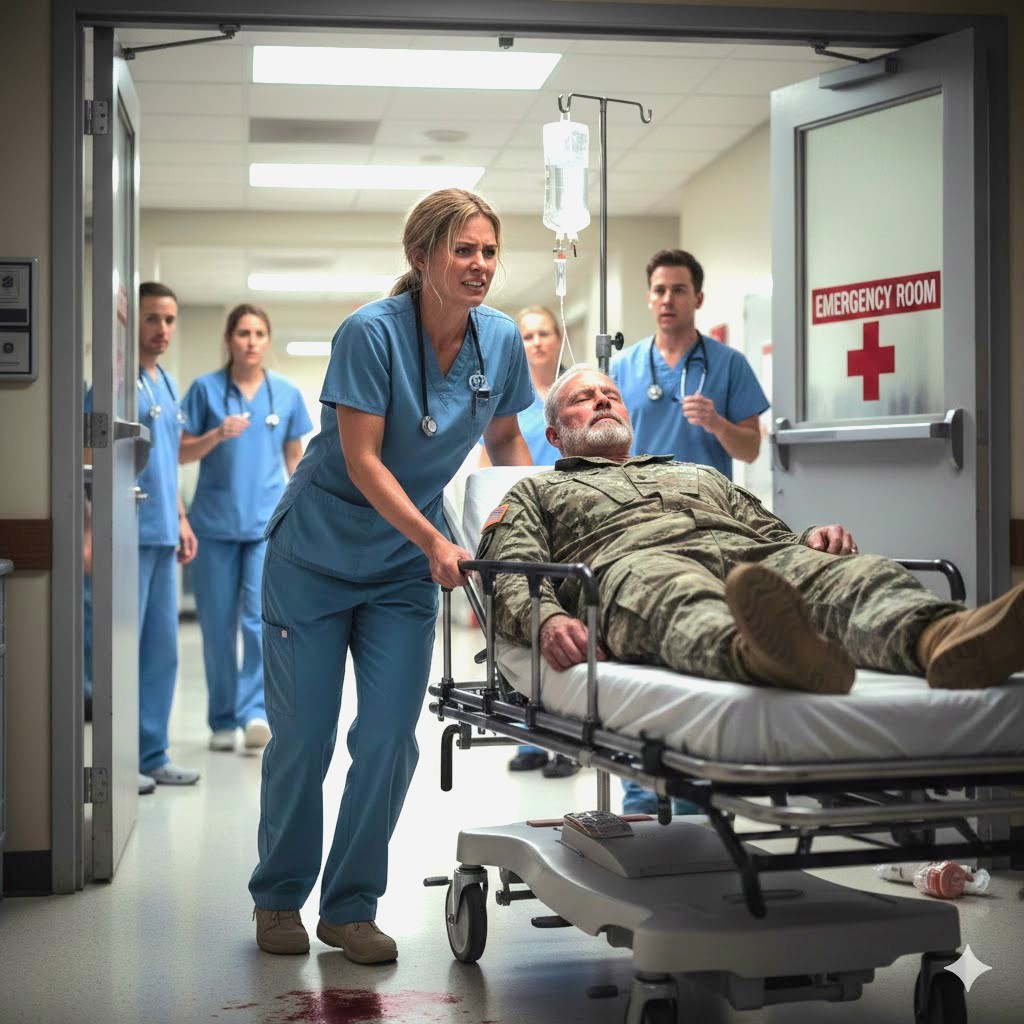
11:47 p.m.
St. Helena Emergency Center.
The doors didn’t open.
They exploded.
A stretcher flew through the hallway so fast that a crash cart nearly toppled. Nurses stumbled aside. Orderlies froze. Even veteran trauma surgeons who thought they’d seen everything stiffened when they saw the uniform.
A Navy SEAL admiral. Motionless. Uniform shredded by five bullet holes. Blood soaking through the tan fabric and dripping off the stretcher rails, leaving a trail behind them like a red thread leading back to whatever battlefield he’d been dragged from.
“Five GSWs, unstable vitals, BP crashing. Move!” the paramedic shouted.
The admiral’s dog tags clattered violently against his chest with every push, echoing down the corridor like a warning bell.
Inside Trauma Room 6, chaos erupted instantly.
A dozen voices clashed.
Hands moved too fast to track.
Machines beeped in frantic disarray.
No one agreed on anything.
“Clamp that!”
“He’s losing too much blood!”
“We don’t have a pulse!”
“He’s coded twice already!”
Surgeons crowded around the admiral, ripping open his uniform, exposing the deep wounds that carved across his torso. Blood soaked the sheets beneath him, staining his skin a dark, terrifying red.
His face was pale—the color of someone who wasn’t supposed to come back.
Through the chaos, someone slipped into the room quietly.
Emma Clark, a rookie nurse, barely seven months into the job, assigned mostly to routine med passes and vital checks because no one trusted her with anything bigger.
She moved like a shadow—calm, silent, unnoticed. Always overlooked.
But not tonight.
She stepped closer to the chaos like gravity was pulling her in, even as senior staff ignored her existence completely.
One surgeon barked, “We’re losing him! Someone get that rookie out of here!”
Another snapped, “She shouldn’t even be in the room!”
Emma didn’t respond.
She simply stared at the admiral.
Something inside her shifted.
Something old.
Something buried.
The way his chest rose in uneven gasps.
The way the blood pooled in specific patterns.
The way his pulse flickered between weak and absent.
The way his breathing choked as if something internal was collapsing.
It wasn’t random.
It was familiar.
The room continued spiraling.
“Pressure’s dropping!”
“Where’s Respiratory?”
“He’s slipping again!”
“Someone do something!”
Emma stepped forward before her brain could stop her.
Her hand moved to the admiral’s neck, two fingers to the exact point she needed, pressing in a way that looked strange to all the surgeons watching.
“Get her away from him!” one doctor snapped.
But Emma didn’t move.
Her eyes narrowed. Her breathing steadied.
She whispered under her breath—not to the room, but to him.
“Stay with me, Admiral.”
Her hands moved with practiced precision. The kind of precision that doesn’t come from nursing school, but from war.
She tilted his airway just slightly, applied pressure in a pattern no civilian medic would know, then adjusted the angle of his oxygen mask.
The monitors spiked.
Beep. Beep. Beep.
A steady rhythm.
The room froze.
“What the—?”
“His pressure is rising.”
“Is that even possible?”
“What did she just do?”
Emma stepped back, chest rising and falling, her calm exterior betraying none of the shock pounding inside her rib cage.
She didn’t want to think about where she’d learned that maneuver.
She didn’t want to remember.
But her body remembered for her.
A dusty tent in Kandahar.
A SEAL teammate bleeding out.
Her commanding officer shouting, “Clark, you’re the only one who can do this!”
A heartbeat that returned because of her hands.
And then the explosion that wiped out her entire unit.
Emma blinked hard, pulling herself back into the fluorescent light of the trauma room.
The admiral’s vitals continued stabilizing on the screen. A miracle by every civilian standard.
The head surgeon turned on her, face red with humiliation.
“You had no authorization to touch him!”
Emma opened her mouth, but nothing came out. She didn’t know how to explain what she did or how she knew how to do it.
“Get out!” he shouted. “You just violated federal protocol.”
A senior nurse grabbed Emma’s arm and pulled her back.
“You shouldn’t have touched him,” she whispered harshly. “He’s not a normal patient. You don’t understand.”
Emma looked at the admiral’s still face, remembering how he had once looked at her across a battlefield. His voice echoed in her memory.
Clark, if I don’t make it, tell them we didn’t go down easy.
She swallowed hard and stepped out of the room.
Ten minutes later, she was standing in the director’s office, badge in one hand, termination papers in front of her.
“You endangered a federal asset,” the director said coldly. “You are dismissed immediately. Security will escort you out.”
Emma didn’t defend herself.
She just nodded, placed her badge on the desk, and walked out with empty hands and a full chest of silence.
Outside the hospital, the night hit her like a cold slap.
Her breath fogged the air. Her scrubs were still stained with the admiral’s blood.
She started walking toward the parking lot—and the ground vibrated beneath her feet.
Engines.
Heavy ones.
She turned.
Ten black government SUVs swung into the hospital driveway, headlights blazing through the darkness.
All ten vehicles stopped at the exact same moment, perfectly aligned.
Doors opened in unison.
Men in black suits stepped out with the synchronized precision of trained operators.
Two nurses inside the building gasped.
Someone whispered, “Oh my God, did the admiral die?”
But Emma knew instantly they weren’t here for a body.
They were here for a secret.
A secret she’d spent years burying.
A man with a cold jawline and a badge that wasn’t marked with any known agency stepped toward her.
“Emma Clark,” he said, voice low but firm.
Emma didn’t respond.
He stepped closer.
“We’ve been looking for you.”
Her pulse hammered. Her breath caught. Her mind screamed to run, but her body stayed still.
The man’s eyes narrowed.
“You saved the admiral once before,” he said quietly. “In Afghanistan.”
Emma’s heart stopped.
He continued.
“And tonight, you saved him again.”
The hospital doors behind them opened slightly as staff watched the scene unfolding—clueless, frightened, desperate to know what was happening.
Emma felt the past claw its way back into her lungs.
The man looked her dead in the eyes.
“And now we need you.”
Her knees nearly buckled.
But the real blow came next.
“Emma,” he said, stepping closer, lowering his voice to a whisper only she could hear. “Your entire SEAL unit wasn’t killed by the enemy.”
He paused.
“Someone betrayed you.”
The world tilted.
Her fingertips trembled.
Her breath shattered in her chest.
And then he said the words that ripped open the wound she’d spent years trying to bury.
“The traitor works in your hospital.”
Emma’s heart stopped cold, and the night swallowed everything around her.
Emma didn’t realize she was shaking until one of the agents stepped forward and placed a steadying hand near—but not on—her elbow, as if approaching a wounded animal.
The hospital’s cold parking lot suddenly felt suffocating, thick with secrets she never meant to revisit.
The neon EMERGENCY sign flickered above them, casting flashes of red across the black SUVs like warning lights.
“Let’s take this inside the vehicle,” the lead agent said. “Not here. Too many eyes.”
Emma looked back toward the glass hospital doors.
Faces pressed against them. Nurses whispering. Doctors staring. The director practically glued to the window in horrified curiosity.
She swallowed hard and turned away.
The last thing she wanted was to give them another spectacle.
The agent motioned to an SUV door.
Emma hesitated, then stepped in.
Inside was warmth, silence, and the faint smell of leather.
The door shut with a heavy thud, cutting off the outside world. The interior lights dimmed automatically.
Two agents flanked her. The lead agent sat across from her with a tablet already open.
Files glowed on the screen, and her stomach twisted.
A photo of her, but not as Emma Clark the nurse.
As Petty Officer Emma Clark.
SEAL combat medic.
Black uniform. Night‑vision goggles lifted onto her helmet, rifle slung across her chest, and a smile she didn’t remember being capable of anymore.
“We never believed you died,” the agent said. “But we didn’t expect you’d resurface as a nurse.”
Emma looked away.
“I didn’t resurface,” she said quietly. “I hid.”
The agent nodded once, acknowledging it without judging it.
“The ambush in Afghanistan,” he said. “The report never added up. Your unit was too experienced, too tactical, too trained to walk into a kill zone like that.”
Emma’s throat tightened.
She saw the images again.
Fire in the sky. Metal twisting. Bodies falling. Her heart pounding in her ears.
“You were the only survivor,” he continued. “But you were badly injured. When you woke up at Landstuhl Hospital, you disappeared before debrief.”
“I didn’t disappear,” she whispered, voice cracking. “I escaped.”
The agent exchanged a glance with another operative.
“Why?”
Emma exhaled long and slow.
“Because I heard two analysts talking outside my room,” she said. “They said… they said the ambush wasn’t random. They said someone sold us out. Someone high enough that it would never go on record.”
She lifted her eyes, tears burning but refusing to fall.
“And I knew if the traitor realized I survived, they’d finish the job.”
Silence filled the SUV.
Heavy.
Electric.
Respectful.
The agent leaned forward slightly.
“Emma, that traitor tried to kill the admiral tonight.”
Emma’s entire body went cold.
“We intercepted communications from inside your hospital,” he continued. “Encrypted messages coordinating the attack. The shooter wasn’t acting alone. Someone in your ER secretly altered his meds when he arrived.”
Emma’s pulse hammered in her neck.
“No. No, that’s—”
But the image of the head surgeon screaming at her. The director firing her instantly. The way everyone rushed to remove her from the admiral’s side.
It wasn’t incompetence.
It was deliberate.
Her hand clenched against her thigh.
“Who?”
The agent tapped the tablet screen.
A blurry surveillance photo popped up.
A man in scrubs. Mask on. Cap pulled low. But the eyes—
Emma recognized those eyes.
No.
No.
It couldn’t be.
Her voice cracked.
“That’s Dr. Halloway.”
The agent nodded.
“Chief trauma surgeon.”
“He was in Afghanistan,” Emma whispered, memories slamming together. “He was consulting on our forward operating base two days before the ambush. He said he was studying battlefield triage.”
Her breath stilled.
“He was mapping our patterns,” she whispered. “He knew exactly where our unit would be the night we were hit.”
“And tonight,” the agent added, “he signed the termination order to get you away from the admiral’s bedside.”
Emma’s stomach twisted in a betrayal so deep it felt physical.
The agent leaned closer.
“He didn’t fire you because you broke protocol,” he said softly. “He fired you because you were the only one who could save the admiral. Because he knew you recognized things no one else could.”
Emma squeezed her eyes shut.
She’d spent years running from her past.
And it had been following her this entire time.
“We need your help,” the agent said.
Emma opened her eyes.
“I’m not a soldier anymore.”
“You don’t need to be,” he replied. “We just need your memory. Your instincts. Your eyes on the scene. You’re the only one alive who knows how the first attack happened and why this one looks identical.”
Emma didn’t speak.
The SUV began moving, pulling away from the ER. Agents in the front communicated quietly through radios, their voices low and urgent.
The lead SUV took point. The rest formed a protective box around her vehicle.
Emma stared through the tinted glass as the hospital shrank behind them.
“Where are we going?” she finally asked.
“To a secure location,” the agent replied. “Someplace where you can talk freely—and where no one can reach you.”
Emma looked back at the hospital once more.
She saw Dr. Halloway standing in the glass entrance, phone raised to his ear, face shadowed in anger rather than worry.
Her chest tightened.
For years, she’d been the quiet nurse no one noticed.
Tonight, she realized why that had kept her alive.
The SUV convoy sped through the empty streets until they turned into an abandoned industrial lot. A warehouse loomed in the darkness, lights flickering to life as the SUVs approached.
The gates slid open automatically.
Inside, the warehouse had been transformed into a mobile command center. Screens lit up with satellite imagery, medical schematics, encrypted messages scrolling in real time.
Emma stepped out of the SUV slowly, breath shaking.
Every agent in the building turned toward her.
Some nodded in respect.
Some stood straighter at her presence.
Some watched her with the kind of awe normally reserved for war heroes.
She wasn’t used to it.
She didn’t want it.
But she felt the weight of it all the same.
The lead agent guided her to a table.
On it were the admiral’s medical chart, the bullets pulled from his uniform in an evidence bag, an encrypted flash drive, surveillance footage from the ER earlier tonight.
And then Emma saw the last item.
A photo—not of her, not of the admiral—but of her entire SEAL unit, smiling, alive, taken the day before they died.
Her knees weakened.
Her fingertips hovered above the image but didn’t touch it.
The agent spoke quietly.
“We believe Dr. Halloway coordinated the ambush in Afghanistan,” he said, “and tonight’s attack was meant to finish the admiral before he could identify him.”
Emma’s throat tightened painfully.
“He was my friend,” she whispered.
“No,” the agent corrected softly. “That’s the mask he wore.”
Emma stared at the board.
The connections. The timeline. The locations.
Everything matched too perfectly.
“He’ll come after me,” she whispered.
“He already tried,” the agent replied. “Firing you was step one. Getting access to you once the admiral died? That was step two.”
Emma swallowed.
“What do you want me to do?”
“Tell us everything,” the agent said. “Walk us through the Afghanistan mission. Every detail. Every instinct. Every moment that didn’t feel right.”
Emma looked at the faces of her fallen teammates.
Then she exhaled slowly and nodded.
“All right,” she whispered. “I’ll help.”
But before the lead agent could speak, an emergency alert blared across the warehouse.
Code Red.
“The admiral is crashing again,” someone shouted.
Emma’s heart lurched.
But the agent’s next words were worse.
“And Dr. Halloway disappeared from the hospital five minutes ago.”
The warehouse fell into chaos.
Emma froze.
Because she realized something horrifying.
Halloway wasn’t running.
He was hunting.
And she was the target.
If you think we should never judge the quiet ones, comment never judge.
For a moment, the warehouse felt suspended in a breathless silence.
Every agent froze.
Screens flickered red with the alert.
Emma stood still, pulse hammering in her ears, as the words repeated in her mind.
The admiral is crashing again. Dr. Halloway is missing.
The lead agent snapped into motion first, barking orders into his comms.
“Lock down the hospital. Secure all exits. No one gets in or out without clearance.”
Operators sprinted across the room, switching feeds, tracing thermal signatures, rerouting satellite images.
Emma’s heart twisted.
If Halloway wanted the admiral dead, this was the moment he’d strike—vulnerable, weak, surrounded by staff trained to trust him. He could slip into the room with a mask and gloves, inject something clear and untraceable, and walk out like nothing happened.
That’s exactly how he did it in Afghanistan.
She stepped forward, breath sharp.
“We need to get back to the hospital. Now.”
The agent turned.
“Emma, you’re not cleared to—”
“No one knows his patterns like I do,” she cut in, voice shaking but steady. “You think this is random? He kills the same way. Same dosage. Same approach. He’s repeating the exact method from our FOB attack.”
She snatched up the admiral’s chart from the table.
“If he wants him dead, he’ll do it himself tonight before federal command arrives.”
The agent hesitated for only half a second.
“Gear up,” he ordered his team. “We move.”
The convoy roared out of the warehouse like a pack of wolves. Engines low. Tires silent. Lights off.
Emma sat in the middle vehicle, flanked by two operators who checked their weapons with clinical precision.
Her fingers dug into her scrub pants, knuckles white.
Her mind replayed the faces of her fallen squad.
Garrett. Silva. Hall. Commander Reyes.
All dead because someone they trusted helped put them in a kill zone.
And now Halloway wanted to erase the last two people who could expose him.
The admiral.
And her.
“You okay?” one of the agents asked quietly.
Emma stared out the tinted window at the rushing streetlights.
“I knew something felt wrong when he fired me,” she said. “I just didn’t want to believe it.”
“He fooled a lot of people,” the agent replied. “But you survived him once. That’s why you’re here.”
Emma swallowed hard.
She didn’t feel brave.
She didn’t feel ready.
She felt like the girl who watched her world burn and ran before the flames touched her.
But she didn’t run tonight.
“Five minutes out,” the driver called.
The agents nodded to each other. Vests adjusted. Earpieces clicked. Weapons checked.
The SUV interior buzzed with controlled energy.
Emma inhaled slowly.
“He won’t go through the front entrance,” she said.
“No,” the agent agreed. “He’ll use a staff access route.”
Emma closed her eyes.
“The service hallway behind Trauma 7,” she said. “There’s a blind spot in the cameras. He’d know that.”
The agent smirked.
“Good. You’re thinking like him.”
Emma hated that she could.
When they reached the hospital, the entire building was lit up.
Police cruisers blocked the main entrance. Nurses huddled outside, whispering frantically. Doctors scrolled through their phones, pale and shaky. Someone cried near the curb.
Emma didn’t stop.
She pushed through them as the agents formed a tight cover around her.
Inside, the ER buzzed with panic.
“We lost his pulse again!”
“Where’s Dr. Halloway? He’s supposed to—”
“Someone check the medication logs!”
“We need ICU backup!”
Emma sprinted toward Trauma 6, but the agent grabbed her wrist.
“Emma, slow down—”
“We don’t have time,” she snapped.
The room was chaos again, but this time it was different.
Frantic. Disorganized. Desperate.
Nurses moved like scattered birds. A junior resident tried and failed to intubate. Someone knocked over a tray. The admiral’s monitors flashed angry red.
The surgeon in charge spun toward the agents.
“Who are you? You can’t just—”
Emma shoved past him.
She looked at the admiral.
Pale. Sweating. Trembling.
But breathing.
Barely.
And then she noticed it.
His IV line.
The fluid bag hanging above him wasn’t one the ER used.
Wrong brand.
Wrong color tint.
Wrong tubing clasp.
“Halloway’s been here,” Emma whispered.
The agents raised their weapons instantly, sweeping the corners.
Emma grabbed the IV line and followed it down to the port.
A faint chemical smell hit her nose, one she knew too well.
The same toxin used in the Afghan ambush.
The same one that collapsed her entire squad in minutes.
Her throat tightened.
“He dosed him, but not fully,” she said. “He’s trying to sabotage slowly so the death looks natural.”
She tore the line free, slamming her hand on the emergency stop switch.
A nurse screamed.
Another gasped.
“You can’t do that!” a doctor shouted.
Emma ignored him.
“Get me fresh saline. Three units. Now.”
“No! She’s fired!” someone yelled. “She’s not supposed to touch him!”
An agent stepped forward.
“She’s federal‑authorized. Move.”
Nurses scrambled.
Emma stabilized the airway with rapid, practiced hands. Her body moved before her mind caught up, instinct replacing thought.
Clamp.
Flush.
Pressure.
Reposition.
Breath.
Monitor.
His vitals rose by a hair—enough to keep him alive.
But she felt it.
A presence.
Eyes.
Someone was watching.
She lifted her head slowly.
There, through the window of the trauma room, a figure stood partly hidden behind a corner wall.
Masked.
Cap low.
Hands still.
Dr. Halloway.
Watching her work.
Watching her undo what he’d spent hours planning.
Her blood ran cold.
He didn’t flee.
He wanted her to see him.
He tipped his head slightly.
Mocking her.
Daring her to come stop him.
Emma’s chest tightened with rage.
“He’s here,” she said.
The agents turned immediately toward the window. Weapons raised.
But Halloway vanished into the hall with chilling calm.
“Lock down the floor!” the lead agent growled.
Emma didn’t wait.
She ran through the trauma wing, past the nurse’s station, down the dim service hall where the lights flickered weakly.
Every step echoed. Her breath hit the air like steam.
She turned the corner and froze.
A body lay on the floor.
A nurse.
Her name badge read: S. Morales.
Pulse faint. Injection mark on her neck.
Emma’s stomach lurched.
“He’s trying to erase witnesses,” she said.
Then she saw something on the wall.
A smeared handprint of blood, dragged fresh.
And next to it, a single word scrawled hurriedly with a finger:
RUN.
Emma stared at it, breath trapped in her throat.
But the agent behind her swallowed hard.
“That’s not a threat,” he said quietly.
“He’s not telling you to run.”
Emma turned, confused.
The agent met her eyes grimly.
“He’s telling you he’s coming.”
Emma’s pulse jolted.
A noise echoed at the far end of the hallway—a rolling cart tipping over, metal crashing to the floor.
The agents raised their rifles instantly.
Emma felt her heart slam against her ribs.
Then, from the darkness at the end of the hall, a figure stepped forward.
Slow.
Deliberate.
Purposeful.
Dr. Halloway.
Gloves on.
Mask up.
Eyes cold.
He lifted a syringe filled with clear liquid and spoke the words that made Emma’s blood freeze solid.
“You were supposed to die with the rest of them, Emma.”
Dr. Halloway’s voice echoed through the dim service hallway, cold enough to freeze the air around Emma.
“You were supposed to die with the rest of them.”
Emma didn’t move.
Didn’t blink.
Didn’t breathe.
The syringe in Halloway’s gloved hand glinted under the flickering industrial light, clear fluid swirling like a ghost inside the barrel.
The same toxin he used in Afghanistan.
The same one he’d already slipped into the admiral’s line.
The same one that almost killed her squad.
Her throat tightened.
“Why them?” she managed. “Why him? Why us?”
Halloway stepped closer, slow and deliberate.
“Because your CO was about to expose a contract that would cost powerful men billions,” he said. “He refused to play along. So he had to go. And your entire squad just happened to be in the way.”
Emma felt something old and dark uncoil inside her chest.
“You killed them,” she whispered.
He shook his head in mock sadness.
“War killed them,” he said. “I just redirected it.”
The agents spread out behind Emma, weapons raised.
But Halloway lifted the syringe, placing the needle gently against his own throat—not to inject himself, but as leverage.
“One step closer,” he warned, “and this hits the bloodstream of the nearest person I touch. Including her.”
His eyes locked on Emma’s.
She felt her heart stutter.
His boots clicked against the floor as he approached. One slow step, then another. The needle glinting like a knife made of glass.
Emma’s mind raced.
She couldn’t let him slip away again.
She couldn’t let him kill another innocent person.
She couldn’t let the ghost of her squad remain buried while their murderer breathed clean air.
But she also couldn’t lunge.
Not yet.
Not until he was close enough.
Two steps.
Three.
Halloway reached her, stopping just inches away. So close she could see the faint splatter of dried blood on his mask.
“You,” he whispered, “were the mistake.”
Emma exhaled, soft and slow, as the memories surged through her like fire.
The explosion.
The screams.
The heat.
Her teammates burning, calling her name.
The admiral dragging her out of the wreckage with one arm, her begging him to leave her.
His voice:
Clark, you’re the only one who knows what he did. Stay alive.
She had survived because the admiral ordered her to.
And now he was on a table fighting for his life again because of the same traitor.
Emma lifted her chin slowly.
“Then let me correct your mistake,” she said.
Before he could react, Emma grabbed the wrist holding the syringe, twisted sharply, and jammed her palm against the nerve point in his elbow—the same move she’d used in Kandahar to disarm an enemy fighter twice her size.
Halloway screamed.
The syringe skidded across the floor.
The agents surged forward.
Halloway kicked Emma hard in the ribs, knocking her to the ground, and sprinted toward the exit.
Two agents tried to block him, but he dodged between them with shocking speed, shoving a crash cart into their path.
Emma coughed, pain radiating through her side, but she pushed herself up instantly.
There was no time.
No space for weakness.
Not now.
She ran down the dim hall, past overturned equipment, past a trail of footprints marked in blood.
She chased him through the ICU wing, breath ragged, heart pounding like artillery fire.
Nurses scattered.
Alarms beeped.
Security shouted as the agents followed.
Halloway burst into the stairwell.
Emma didn’t hesitate.
She dove after him, grabbing the back of his coat.
They both tumbled down the first step, slamming into the railing.
Halloway elbowed her in the shoulder and bolted down the stairs two at a time.
Emma gritted her teeth and followed.
Second floor.
Third.
Fourth.
Each landing another echo of her past.
The chase.
The danger.
The war she thought she’d left behind.
At the bottom, Halloway burst into the basement, a place filled with pipes, shadows, and humming generators.
He grabbed a metal pipe from the floor, swinging it in a wide arc.
Emma dodged.
The pipe slammed into the concrete pillar behind her with a deafening clang.
“Just die!” he roared.
Emma ducked another swing and swept his legs, knocking him to the ground.
She climbed onto him, pinning his arm with her knee.
“You killed my squad!” she screamed.
“And I’ll kill you too,” he spat.
But he couldn’t move—not with her weight on his chest, not with her elbow crushing his tricep, not with agents closing in from every direction.
Halloway thrashed one last time.
Then Emma drove her forearm into his throat, stopping him cold.
The syringe he’d dropped earlier lay at the edge of the room, glinting faintly.
Emma reached out, slid it toward her, and held it up between them.
“You used this to kill my brothers,” she whispered. “To kill the admiral. To kill me.”
Halloway stared at her, eyes wide, frantic.
“You wouldn’t,” he hissed.
Emma tightened her grip.
“No,” she said, voice like ice. “But I will make sure you never hurt anyone again.”
The agents swarmed him, dragging him up, cuffing his wrists behind his back.
As they hauled him away, Halloway’s voice cracked.
“You think the admiral will live?” he shouted. “He won’t make it. I dosed him too much.”
Emma froze.
The words ripped through her chest like shrapnel.
“No,” she whispered. “No. He can make it. He has to.”
“We need to get to him,” an agent urged. “Now.”
They ran back through the hospital corridors, pushing past staff, officers, chaos—straight to Trauma 6.
The moment Emma stepped inside, her breath caught.
The admiral lay still.
Too still.
Doctors stood frozen.
Nurses cried softly.
The monitors showed a thin, irregular line.
Emma ran to his bedside.
“Move,” she ordered, voice cracking.
She grabbed his hand.
“Admiral,” she whispered, her tears finally breaking free. “You fought for me in Afghanistan. You held me while I bled. You carried me. You told me to live. So you don’t get to leave now. You hear me? Not now.”
His vitals flickered.
Emma placed her palm on his chest, eyes squeezed shut.
“Come back,” she begged. “Come back. Please.”
A long, suffocating silence filled the room.
And then a sound.
Beep.
Beep.
Beep.
The line steadied.
Emma collapsed forward, her forehead falling onto his shoulder as relief shook her entire body.
The admiral’s eyelids fluttered open weakly.
“Emma,” he whispered, voice thin and broken. “You survived.”
“So did you,” she whispered back.
Agents flooded the room.
The director stumbled in, pale.
Nurses gasped.
Doctors stepped back in awe.
The lead agent approached Emma with a sealed envelope.
“You ended a traitor’s operation,” he said softly, “and saved a national hero. Federal command is giving you this.”
Emma opened the envelope.
Inside was a letter of reinstated identity.
A federal pardon.
A medal of valor recommendation.
And a certified transfer: five million dollars.
“For your survival,” the agent said. “And for your silence—until now.”
Emma stared at it, tears filling her eyes.
She didn’t care about the money.
She cared that her squad wasn’t forgotten.
That their deaths meant something.
That justice found the man who betrayed them.
The admiral squeezed her hand weakly.
“You’re still the best medic I ever had,” he murmured.
Emma broke completely, burying her face into his shoulder as the entire room watched.
She wasn’t invisible anymore.
She wasn’t forgotten.
She wasn’t a ghost.
She was Emma Clark.
The last SEAL medic.
The admiral slept for almost eighteen hours.
Emma didn’t.
After the adrenaline crashed out of her bloodstream, exhaustion hit like a freight train. Her ribs throbbed where Halloway’s kick had landed. Her hands shook when she tried to drink coffee. The fluorescent lights of St. Helena, the smell of antiseptic and saline, the beeping of monitors—it all pressed in on her like the walls of a too‑small room.
But every time a nurse peeked into Trauma 6 and glanced at the monitor, the line was still steady.
Beep.
Beep.
Beep.
He was alive.
She’d pulled a chair up to the foot of his bed, not close enough to get in anyone’s way, but close enough that if he coded again, she’d be there. She sat with her elbows on her knees, fingers threaded together, eyes half‑closed but never fully shutting.
Agents came and went. Some spoke in low, clipped sentences near the door. Others stood at the corners of the room, watching anyone who entered like hawks. The director tried to storm in once, red‑faced and sputtering, demanding to know under what authority a “terminated nurse” was still in his hospital.
The lead agent simply held up a badge Emma had never seen before and said, “Under this one.”
The director turned as pale as the admiral and backed out, mumbling something about liability.
At some point, a nurse she didn’t recognize brought Emma a blanket.
“You look like you’re going to fall over,” the nurse said.
“I’m fine,” Emma lied automatically.
The nurse snorted.
“You just tackled a federal traitor in the basement. It’s okay to sit down, Clark.”
Emma blinked.
Clark.
Not “rookie.”
Not “her.”
Clark.
She wrapped the blanket around her shoulders and sat.
For the first time in years, she let herself simply… exist.
No running. No hiding. No pretending she was just a quiet nurse from nowhere with a normal past.
It was almost more terrifying than the warehouse.
The admiral woke up just after sunrise.
Light seeped around the edges of the blinds. The night shift swapped out with day. The hospital hummed with the low, familiar noise of morning—med carts rolling, coffee being poured, the overhead speaker crackling with codes that had nothing to do with her.
Emma’s head had dropped forward onto her chest.
“Clark,” a voice rasped.
Her eyes snapped open.
For a second, she wasn’t in Trauma 6. She was back in Kandahar, smoke in the air, dust clinging to her face, someone yelling her name through the ringing in her ears.
“Clark!”
Her heart jerked.
She looked up.
The admiral’s eyes were open.
Cloudy, tired, rimmed with red.
But awake.
He stared at her for a moment, unfocused. Then his gaze sharpened, like a lens clicking into place.
“Emma,” he said again.
His voice sounded like gravel scraped over steel.
She stood, the blanket sliding off her shoulders.
“Yes, sir.”
He exhaled, a shaky laugh that turned into a cough.
“Sir,” he murmured. “You remember how many times I told you not to call me that off the clock?”
“Last time I checked,” she replied, gripping the side of the bed to steady herself, “we’re very much on the clock, Admiral.”
His hand shifted weakly, as if reaching for something.
The monitors beeped, measuring every stutter of his heart, every shallow breath.
“You made it,” she said.
“You did,” he countered. “Twice.”
His gaze flicked past her shoulder.
Agents in the corner straightened.
“Status?” he asked, the command instinct reflexive.
“Stable for now, sir,” the nearest agent said. “We’ve got Halloway in custody. He’s being transported to a federal holding facility as we speak.”
The admiral’s jaw tightened.
“Halloway,” he repeated slowly, like a man tasting poison. “I always knew there was a leak. Didn’t expect it to be the man writing my post‑op orders.”
Emma swallowed.
“What do you remember?” she asked.
His eyes returned to her face.
“I remember a parking garage,” he said. “My driver insisting we use the secure exit. A car we didn’t recognize. Three shooters. Good ones. Close range.”
He looked down at his chest, at the white gauze under the flimsy hospital gown.
“They were supposed to finish the job in surgery,” Emma said quietly. “Halloway dosed your line. Slow sabotage. Enough to kill you by morning without anyone asking too many questions.”
“Subtle,” the admiral murmured. “Too subtle. He underestimated you.”
Emma looked away.
“He underestimated a lot of people,” she said.
A nurse slipped in to check his vitals. She flinched when she saw the cluster of agents in the room.
“I just need his blood pressure,” she said nervously.
“It’s okay,” Emma told her. “Go ahead.”
The nurse wrapped the cuff around his arm, eyes darting between the admiral and the agents.
“You…” she said to Emma softly. “You saved him. Twice? Is that true?”
Emma shifted, uncomfortable.
“I was just in the right place.”
The nurse gave her a look.
“The right place would be at home in bed,” she said. “You were in the impossible place.”
She finished the BP reading and left.
Silence stretched for a moment.
Then the admiral cleared his throat.
“That night in Afghanistan,” he said, each word deliberate, “when I pulled you out… I thought you died on the Medevac.”
Emma’s chest tightened.
“So did a lot of people,” she said.
“I read the field report,” he went on. “KIA. No body recovered.”
“That’s one way to stay off the radar,” she whispered.
His eyes sharpened again.
“You disappeared,” he said. “No debrief. No follow‑up. Just… gone.”
Emma wrapped her arms around herself.
“I woke up at Landstuhl,” she said. “There were tubes in my arms. Monitors everywhere. I couldn’t move my left leg. My head felt like someone had taken a hammer to it.”
She remembered the sound of the rain against the German hospital windows, the smell of sterility and coffee.
“And then I heard them,” she said. “Two intel analysts in the hallway. Talking like I wasn’t there. Like I was just a name on a list.”
Her voice dropped.
“They said the ambush wasn’t a failure of intel,” she continued. “They said it was a clean op. That someone high enough to have full mission access signed off on it. Sold us out. And that ‘unfortunately, one of the medics made it out.’”
The admiral’s jaw clenched.
“They were talking about you.”
“I looked in the mirror,” she said. “I saw the scars. The bruises. The stitches. I thought about walking into a briefing room and telling a room full of men who outranked me that one of their buddies orchestrated the murder of my squad. And I realized…”
Her throat closed.
“…they’d either bury it. Or bury me.”
The admiral didn’t argue.
He just watched her.
“So I took my IV out,” she said. “I stole a pair of scrubs and a wheelchair. I rolled out the loading dock, got in the first contractor van headed nowhere, and I vanished.”
She looked up at him.
“Until tonight.”
“Until tonight,” he echoed.
The lead agent stepped closer.
“General,” he said, acknowledging the admiral’s rank even if the man was half‑conscious, “we’ve secured immediate threats. But the conspirators we’re dealing with are… entrenched.”
“Tell me something I don’t know,” the admiral muttered.
The agent looked at Emma.
“We need both of you,” he said. “Not as patients. As witnesses. As subject‑matter experts. As the only surviving people who were on the ground then and in the room tonight.”
“I’m a nurse,” Emma said reflexively.
“You’re a SEAL combat medic,” he corrected. “Who just neutralized a traitor and recognized a field toxin by smell.”
Emma had no response to that.
“Not right now,” the admiral managed. “Right now, I’m a patient. And she’s about two breaths from keeling over.”
Emma opened her mouth to protest.
The agent held up a hand.
“He’s right,” he said. “We’ll set up debriefs later. You both need rest.”
Emma bristled automatically.
“I’m fine,” she began.
The agent’s gaze flicked to the faint bruises blooming on her ribs, the way her hand trembled when she pushed hair back from her face.
“You’re human,” he said. “And you just survived something most people wouldn’t walk away from once. You did it twice.”
She looked at the admiral.
He met her eyes.
“No one’s taking this away from you,” he said. “Not this time. Not your story. Not what you did.”
For a long second, Emma just stood there.
Then she nodded.
“Fine,” she said. “But I want something in writing.”
The agent raised an eyebrow.
“Already in progress,” he said. “Your identity. Your service record. The truth about what happened to your unit. There will be classified pieces, but we’re not pretending you’re dead anymore.”
A strange, unexpected fear flashed through her.
For years, being dead had been her shield.
Without it, the world felt suddenly… exposed.
“Get some rest,” the admiral said softly. “Doctor’s orders.”
She half‑laughed.
“You’re not a doctor,” she said.
“Admiral’s orders then,” he replied.
She pulled the blanket tighter around her shoulders and backed toward the door.
As she stepped out, he called her name.
“Emma.”
She turned.
“Yeah?”
“Thank you,” he said.
There wasn’t enough air in the room.
She nodded once and slipped out before the tears could reach her eyes.
They gave her a cot in a windowless room off the command center.
Not exactly a hotel suite, but it was clean, quiet, and there were no monitors beeping at her.
Emma lay on her back and stared at the ceiling.
Sleep didn’t come.
Every time she closed her eyes, she saw the flash of the ambush. The fire. The silhouettes of her teammates going down. Halloway standing at a distance, hands in his pockets, watching casually as if he were observing a training exercise.
She rolled onto her side.
A small metal box sat on the table next to her cot.
Her name was written on a sticky note attached to it in block handwriting.
She hesitated, then flipped the latch.
Inside were her dog tags.
Her original tags.
The ones she’d handed in when she’d “died.”
The metal was familiar against her skin when she lifted them out.
“Someone’s idea of a welcome home gift,” a voice said from the doorway.
She looked up.
The lead agent—she still didn’t know his name—leaned against the frame, arms crossed.
“Can’t decide if that’s morbid or thoughtful,” she said.
“Bit of both,” he replied.
He stepped inside, closing the door behind him.
“Hard to sleep after something like that,” he added.
“Understatement,” she said.
He nodded toward the tags.
“Command signed off on everything,” he said. “Officially, you’re no longer dead.”
“Great,” she muttered. “Now I have to pay taxes again.”
That startled a laugh out of him.
“Of all the things to worry about…”
“You don’t know how many false identities I’ve burned through over the years,” she said. “It’s a lot of paperwork.”
He stepped closer.
“I realized we never properly introduced ourselves,” he said. “Special Agent Ryan Cole.”
She looked at his extended hand for a moment, then shook it.
“Emma,” she said. “But I guess you knew that.”
He shrugged.
“We knew ‘Clark.’ We didn’t know the woman working nights at St. Helena, taking extra shifts no one wanted, keeping her head down.”
She frowned.
“You’ve been watching me?”
“Not as long as you’d think,” he said. “We picked up chatter about an asset who’d ‘slipped the net’ years ago. Female. Medic. Tied to a mission that didn’t officially exist. Once the admiral survived his first surgery, and your name showed up on the nursing roster…”
“You connected the dots,” she finished.
He nodded.
“We needed to be sure. People like Halloway don’t operate alone. They usually have friends in high places. We couldn’t risk tipping our hand too soon.”
She stared at the dog tags.
“People like Halloway,” she repeated. “Doctors. Officers. People you’re trained to trust.”
“People who count on that trust to cover their tracks,” Cole said.
Emma sat up, bare feet on the cold floor.
“So what happens now?” she asked. “To him. To me.”
“To him?” Cole said. “He’s going away. For a long time. Maybe forever. Once we finished processing the evidence from tonight and cross‑referenced it with the Afghanistan intel you provided… it’s airtight. He’ll be facing charges he can’t buy his way out of.”
He paused.
“To you?” he continued. “That’s… more complicated.”
“Story of my life,” she said.
“You have options,” Cole said. “You can take the package we offered. The financial settlement. The pardon. The clean slate. Walk away, if that’s what you want. We’ll safeguard your record. Make sure your squad’s names are cleared on the classified side, even if the world never reads those pages.”
Emma’s throat tightened.
“And if I don’t walk away?” she asked.
Cole studied her face.
“Then we put your experience to work,” he said. “Quietly. Off the books. There are teams out there that could use someone who understands both sides of the line. Hospital corridors and hot zones. You wouldn’t be going back to kicking doors. Those days are behind you. But training. Consulting. Helping us spot patterns the rest of us miss.”
She thought about St. Helena.
The way the senior staff had treated her like a nuisance. The director’s contempt. The way she’d spent months hiding in plain sight, pretending she was less than she was just to feel safe.
“You want me to go back to being a soldier,” she said softly.
“I want you to decide,” Cole replied. “For once.”
She blinked.
“Every major decision in your life so far has been reactive,” he said. “Your unit gets ambushed. You run. You need to eat. You pick up a nursing degree. You need to stay invisible. You take the quietest shifts. Tonight was the first time in years you stepped toward danger instead of away from it.”
“I didn’t exactly stop to think about it,” she said.
“Exactly,” he said. “Because underneath all the layers of fear and grief, you’re still who you were trained to be.”
She looked at him.
“A medic,” she said.
“A protector,” he corrected. “You move toward the dying when everyone else steps back.”
She stared at the floor.
“You think I owe it to them,” she said quietly.
“To who?”
“My squad,” she said. “The admiral. The guys who didn’t make it back. The patients I couldn’t save.”
“I think you owe it to yourself,” Cole said. “To stop living like a ghost.”
The words landed harder than she expected.
She’d been a ghost for so long.
Seen, but unseen.
Present, but not really there.
In Kandahar. In Landstuhl. In St. Helena.
Always in the corner of someone else’s story.
Never the main character in her own.
She picked up the dog tags again, the metal cool against her palm.
“I don’t know if I can,” she admitted. “Go back into that world.”
“You’re not going back,” Cole said. “You’re going forward. On your terms. With more power than you had before. That’s a very different thing.”
She looked up at him.
“What if I fail?”
Cole smiled—tired, sincere.
“Then you fail,” he said. “And we pick up the pieces. That’s what teams do.”
She sighed.
“I’m still a nurse,” she said.
“No one’s asking you to stop being one,” he replied. “We’re asking you to stop pretending that’s all you are.”
Silence settled between them.
This one felt different.
Not empty.
Open.
“I’ll think about it,” she said.
“That’s all I’m asking,” he replied.
He turned to go, then paused at the door.
“For what it’s worth,” he added, “my little sister’s a nurse. She says you’re the reason half of her TikTok feed is people crying over patient stories.”
Emma choked out a laugh.
“Great,” she said. “Tell her to log off once in a while.”
“I tried,” he said. “She threatened to diagnose me with something.”
The door closed behind him.
Emma lay back down and stared at the ceiling again.
This time, when she closed her eyes, the images that came weren’t just fire and smoke.
They were also the admiral’s hand in hers.
The sound of his voice saying, You survived.
The sight of ten black SUVs pulling up not to drag her away, but to pull her back into a world where her skills meant something.
She slept.
And for the first time in a long time, she didn’t dream of dying.
She dreamed of standing.
Three weeks later, Emma walked back into St. Helena through the main entrance.
This time, no stretchers flew through the doors.
No admiral bled on the tiles.
Just the usual late‑afternoon crush: visitors clutching plastic bags from the gift shop, an elderly man arguing with the volunteer at the information desk, a toddler screaming because someone had the audacity to tell him he couldn’t climb on the fish tank.
Emma adjusted the strap of her backpack on her shoulder and kept walking.
It felt surreal to be here as herself.
Not under a false last name.
Not as “the rookie.”
Just… Emma.
She wasn’t wearing scrubs.
She wasn’t on the clock.
She was wearing jeans, a plain T‑shirt, and a soft flannel jacket that hid the faint bruises that had just finished fading.
Her hair was pulled back in a low ponytail.
Her badge—a new one, with her full legal identity restored—sat in her pocket.
She wasn’t here to work.
She was here to say goodbye properly.
The elevator dinged.
She stepped in.
Two nurses squeezed in after her, mid‑discussion.
“…I’m telling you, it was like something out of a movie,” one whispered. “SUVs, agents, the whole floor on lockdown—”
“The director almost peed himself,” the other said. “I still can’t believe it. And that nurse—”
They both fell quiet when they realized she was there.
“Sorry,” one of them said quickly. “We’re not supposed to gossip about…”
Her eyes widened.
“Wait. You’re her.”
Emma blinked.
“I’m… who?”
“The one from that night,” the nurse said. “The SEAL medic. You tackled Dr. Halloway in the basement.”
Emma’s first instinct was to deny it.
To shrug. To shift. To disappear.
Instead, she took a breath.
“Yeah,” she said. “That was me.”
The second nurse stared.
“You saved Admiral Rourke,” she said. “My uncle’s in the Navy. You’re all they’re talking about on base. There are rumors you once restarted someone’s heart in a helicopter with a spoon.”
Emma snorted.
“That’s… not how that works,” she said. “At least, I hope not.”
The nurses laughed.
“We’re glad you’re okay,” the first one said. “And… thank you.”
Emma’s throat tightened.
“Just doing my job,” she said.
But this time, she didn’t mean it as a way to shrink herself.
She meant it literally.
The elevator doors opened on the administrative floor.
She stepped out.
The hallway looked the same: beige walls, framed motivational posters about “compassion” and “excellence,” a plant that somehow managed to die despite being fake.
She walked straight to the director’s office.
His assistant froze when she saw Emma in the doorway.
“Can I help you?” she asked, voice straining for politeness.
“Is he in?” Emma asked.
“Yes, but he’s in a meeting with—”
The door opened.
The director’s face appeared, mid‑sentence, then stopped.
He went very still.
“Clark,” he said.
“Actually,” she said, “it’s Petty Officer Clark. Or just Emma. I’ll take either.”
His eyes flicked to the man standing behind him.
Admiral Rourke.
In uniform.
On his feet.
He leaned on a cane, still a little pale, a little thinner than before, but upright.
“Director,” the admiral said, “I asked Ms. Clark to join us.”
You could have heard a pin drop.
The director’s Adam’s apple bobbed.
“Yes, Admiral,” he managed. “Of course.”
“Let’s talk inside,” the admiral said.
Emma stepped in.
The office smelled like overpriced coffee and fear.
The admiral eased himself into a chair, motioning for Emma to sit beside him. The director took the seat behind his desk, hands folded so tightly his knuckles turned white.
“St. Helena is under federal review,” the admiral said without preamble. “Not because of your staff. Most of them performed admirably under pressure. But because of failures in leadership.”
The director swallowed.
“Admiral, with all due respect—”
“I read the incident reports,” Rourke said. “Every one of them. I saw how quickly you signed off on Emma’s termination. How eager you were to remove the one person who was actually keeping me alive.
News

5 anh em cãi vã om sòm ngay trong đám giỗ mẹ vì 2 yến thịt lợn
Chẳng nhà ai như gia đình tôi, chị dâu, em chồng lớn tiếng cãi nhau ngay trong đám giỗ mẹ chỉ vì 2 yến thịt lợn, khiến tình cảm rạn nứt. Bố tôi mất đã nhiều năm. 2 năm trước,…
Một gia đình 4 người lần lượt đi xuống tầng hầm và không bao giờ trở lại: Thủ phạm hóa ra lại là củ khoai tây
Bé gái 8 tuổi – người duy nhất sống sót trong nhà đã phát hiện ra cảnh tượng kinh hoàng. Tờ Mirror đưa tin về vụ việc xảy ra ở Laishevo vào ngày 27 tháng 10 năm 2014. Một cô…

Hơn 90% người dùng điện thoại iPhone không biết công dụng của chiếc lỗ nhỏ cạnh camera
Chiếc lỗ nhỏ cạnh cụm camera sau là chi tiết quen thuộc với người dùng iPhone, nhưng không nhiều người biết công dụng thực sự của nó. Nếu quan sát mặt sau của iPhone, không ít người sẽ nhận thấy…

Sát Tết dương, nhà chồng báo lên chơi 20 người, ăn uống nhậu nhẹt thả phanh còn đi siêu thị mua núi đồ, bắt con dâu chi hết
Lan và Minh sống ở căn nhà ba tầng khang trang giữa Hà Nội. Tết Dương lịch năm nay rơi vào cuối tuần dài, Minh hào hứng bảo vợ: “Nghỉ mấy ngày, mình đi Đà Lạt chơi cho mát”. Lan…

Vợ đi công tác 1 tháng, tôi đến tìm vợ cũ nhưng người mở cửa khiến tôi sốc đứng không vững
Cửa mở và tôi chết lặng. Không phải vợ cũ… Vợ tôi đi công tác đúng một tháng, chuyến đi dài nhất kể từ ngày cưới. Trước lúc đi, cô ấy còn cẩn thận dặn từng việc nhỏ trong nhà,…

Đúng ngày đầy tháng của con, tôi bật lại mẹ chồng ngay giữa bữa tiệc gia đình, chồng lao vào t;á;t tôi không chút thương xót
Chỉ một câu nói nửa đùa nửa thật của mẹ chồng trong ngày đầy tháng con, tôi không kìm được mà bật lại. Cái giá phải trả là một cái tát từ chồng và phải ôm con bỏ về nhà…
End of content
No more pages to load